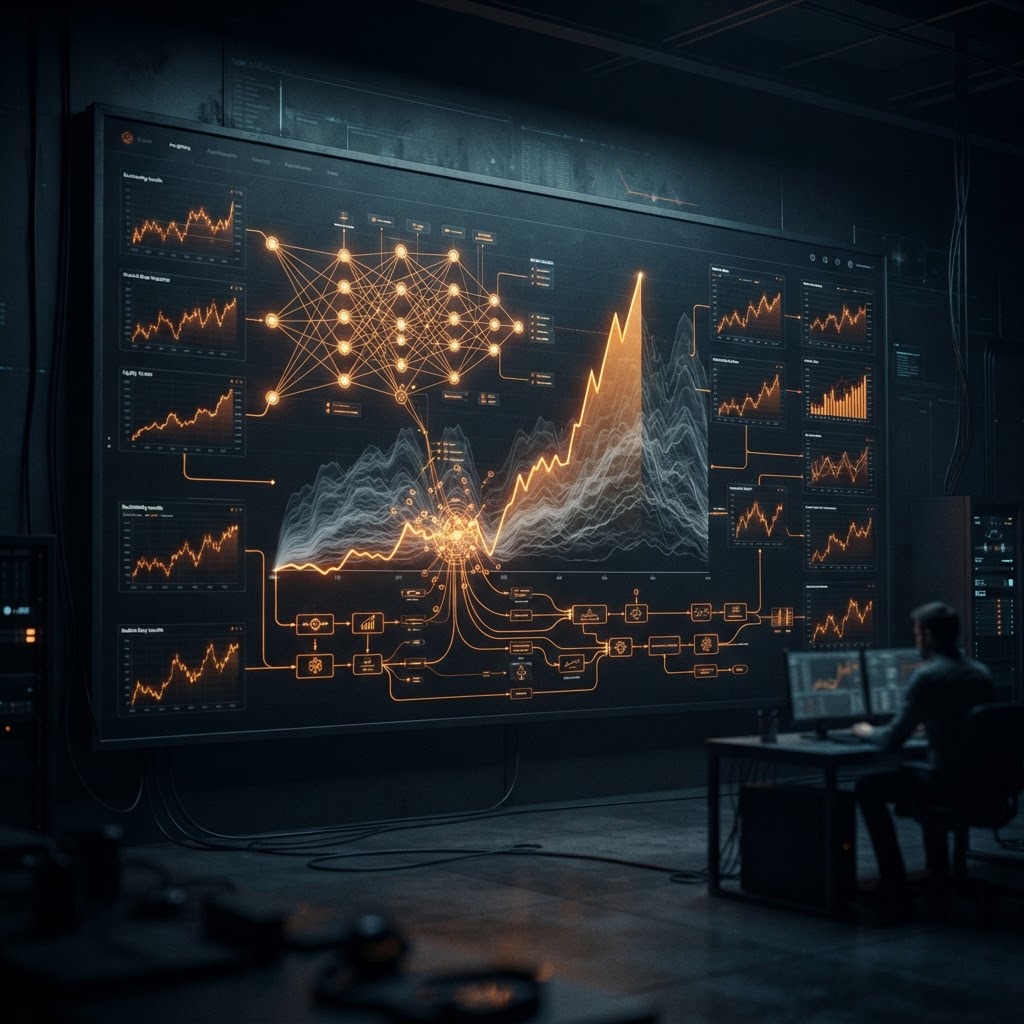
Over the past six months, we've built something that tests trading strategies at a scale no human can: an AI trading workflow engine.
Every evening it wakes up, scans decades of market data, tests hundreds of strategy variations, backtests the survivors on two real brokers' data — and by morning there's an answer waiting: what died, what survived, and why.
Six months in, here's the number that matters: over 10,000 strategy configurations tested. Fewer than ten survived.
Most people read that as failure. It's the opposite. That kill rate is the entire product — and in this article we'll show you exactly how the machine works, what it has killed, and the first survivor — which will be released for purchase in the near future.
The problem: backtesting lies to you
We've spent years testing trading strategies the manual way, and here's what that process really looks like: you get attached to an idea, you spend three weeks coding and backtesting it, and by the end you want it to work. So you nudge the date range. You ignore commission. You tune the parameters until the equity curve looks right.
Every retail trader does this. Most don't know they're doing it.
And the tooling makes it worse. Your broker's strategy tester runs on a few thousand bars of chart history with idealised fills. A strategy that "makes money" there can lose money the moment real spreads, real commission, and real tick-level fills enter the picture — we'll show you a concrete example below.
The fix isn't discipline. It's removing the human from the loop at the moments the human can't be trusted — and testing at a scale where luck can't hide.
The engine: a nightly research pipeline
Here's what runs autonomously, end to end, every single night:
1. Data — millions of bars, not thousands
Locally stored, professionally sourced historical data: FX majors and crosses back to 2019, gold and indices back to 2020, commodities back to 2018 — down to 1-second resolution where it matters. The gold dataset alone is 67 million bars. Most retail backtests run on a few thousand bars of broker chart history. That's not research; that's astrology.
2. Pre-registration — rules fixed before results
Every strategy family's rules and parameter grids are locked before the engine looks at a single result. If you decide what you're testing after seeing the data, you're not testing — you're curve-fitting with extra steps. This is the same standard used in clinical trials, applied to trading research.
3. The statistics gauntlet
Every candidate must survive all of the following:
- •The drift test. Is this strategy actually skilled, or was it just long an asset that went up? Most "gold strategies" are just… long gold. We strip the underlying market drift out first and ask what's left.
- •Out-of-sample validation. The strategy must keep working on data it was never tuned on. In-sample brilliance is worthless.
- •The multiple-testing penalty. Test 500 variations of anything and a few will look brilliant by pure luck. We mathematically deflate every result for the number of trials behind it (the Deflated Sharpe Ratio). This one gate kills more "amazing" backtests than any other.
- •A synthetic null test. We destroy the edge in resampled data and check the real result still stands out from the noise floor.
- •Real costs. Spread AND commission, modelled conservatively per instrument. Commission alone kills entire strategy families — especially anything that trades frequently.
- •An economic rationale. If we can't explain why an edge should exist, it doesn't ship — no matter what the numbers say.
4. Automated robot builds
Survivors are built as MetaTrader 5 Expert Advisors, compiled to zero errors, zero warnings, with every risk control (stops, position caps, daily loss limits) built in from day one.
5. Dual-broker validation
Each robot is then backtested — headlessly, automatically — on two independent real brokers' data, including 100% real tick history where available. This step matters more than almost anything: if a strategy only works on one data feed, it doesn't exist. We've caught "edges" that were nothing more than one provider's data quirk.
6. The morning report
By 7am there's a written verdict. What used to take weeks per idea now takes one overnight run per family of ideas. We've run more rigorous strategy research in the last six months than in the previous six years of doing it by hand.
What the engine has killed
This is the part nobody selling a trading course will show you. A sample from the graveyard:
- •ICT / "Smart Money Concepts" — zero survivors. A full combinatorial scan across 14 symbols: order blocks, fair value gaps, liquidity sweeps, every stack and combination. Nothing passed the gate. A plain opening-range breakout beat every SMC combination we tested.
- •The 97%-win-rate marketplace robots. We reverse-engineered several top-selling systems. Behind the win rate: grid/martingale mechanics with unbounded risk. Worse, their profits were often fill artifacts — one system that made +$492 on bar-level data made −$129 on real tick data. Same strategy, same period; the only difference was honest fills.
- •Famous YouTube strategies, codified rule-for-rule. Every literal, testable version failed after real costs. Where those traders make money, the edge is discretionary — it isn't in the rules they teach.
- •Our own darlings. A grid system we were genuinely excited about got pulled the moment real-tick testing refuted it. Several of our own ideas died the same way. The engine doesn't care whose idea it was. That's the feature.
- •The look-ahead trap. One scan showed profit factors of 3–5 — spectacular — until the engine's checks caught the truth: the code was accidentally peeking at future data. The pipeline now catches that entire class of bug automatically. If your backtester can lie to you, eventually it will.
Over ten thousand configurations tested. Fewer than ten survived. That's not a failure of the engine. That is the engine.
The first survivor
One strategy has now passed the full gauntlet — and the story of how it got there is the best demonstration of the process.
The find. One of the engine's scans flagged something odd: a systematic, repeating effect in a basket of major currency pairs. Initial numbers were striking — statistically significant at levels that are lottery-odds unlikely to be luck, and positive every single year tested.
The twist. We cross-checked it on an independent data source — and it failed. Two reputable data feeds, opposite answers. A typical retail trader would have traded it anyway. Our rule is absolute: unconfirmed means untradeable.
The verdict. The tiebreaker was the only data that ultimately matters — the broker's own. We ran the built robot against real broker data in the MT5 tester: confirmed. Profitable every year for nine straight years in backtest, with a maximum drawdown you can actually live with.
What we can say about it. It's simple — a handful of readable rules, no indicators to babysit, no screen time. It's a portfolio sleeve, not a get-rich-quick bot: modest, steady, and near-zero correlation with trend or breakout strategies — which is exactly why it's valuable in a portfolio. It's also deeply unsexy, which is precisely why the edge was still lying there, untouched. Nobody was looking.
This system will be released for purchase in the near future. Every purchase includes the robot, the exact settings files, and the full research verdict behind it — the complete breakdown, including the parts we're deliberately not publishing here. [→ Sign up / follow us to be notified when it launches]
What's next
The engine doesn't stop. It runs every night, and there's a pipeline of further candidates behind this first release — a trend-pullback system on gold, a volume-confirmed breakout on the Nasdaq, an FX mean-reversion basket — each one working through the same gauntlet before it's ever offered for sale. Released systems stay under ongoing monitoring too: if the data ever says an edge is decaying, we'll say so — we don't quietly keep selling it.
The AI doesn't predict markets. It does something more valuable: research grunt-work at superhuman scale, with a statistical honesty no human under deadline pressure can sustain. The strategies that come out the other end are simple, readable rules — the intelligence is in the filtering.
Six months ago we tested strategies. Now we run a machine that kills them — and only ships the ones it couldn't kill.
Questions about the methodology, the data, or the new algorithm (coming soon)? Get in touch — or better, ask in the comments. We answer everything.
⚠ Trading involves substantial risk. Backtested results are historical and are not a guarantee of future performance. Nothing in this article is financial advice.